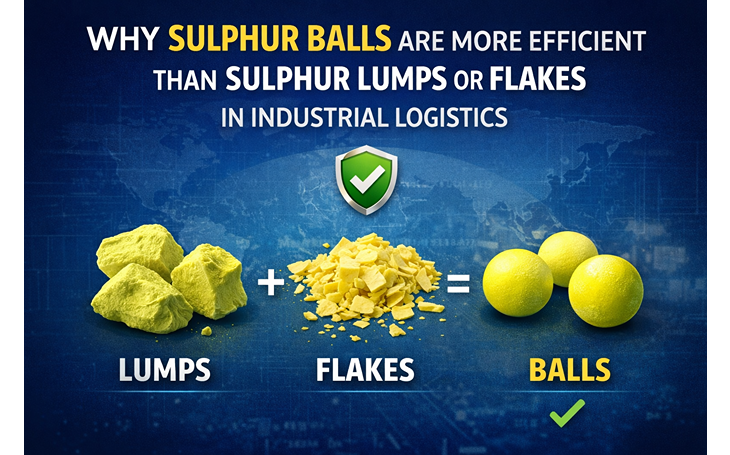
Why Sulphur Balls Are More Efficient Than Sulphur Lumps or Flakes in Industrial Logistics
Sulphur is used everywhere in industry, but how it is shipped makes a huge difference to cost, safety and operational efficiency. Buyers often compare three physical forms of sulphur: lumps, flakes and spherical sulphur balls. Although they may share similar chemical composition, they behave very differently during transportation, storage and processing. For international buyers handling large volumes, sulphur balls are the most efficient and reliable option.
This is why industries are shifting away from lumps and flakes and choosing spherical product for long distance trade.
Uniform Shape Makes Packaging Easier
Sulphur balls are manufactured to be round, dense and consistently sized. This uniformity is more than a visual detail. It directly influences how the material settles inside containers and jumbo bags. Round particles pack tightly and fill space evenly. This reduces air gaps, stabilizes cargo and lowers the chance of pressure buildup.
Lumps and flakes are irregular. Sharp edges and uneven sizes create voids and unstable surfaces. When these products are loaded, the container often needs extra padding and angle adjustments to prevent cargo movement. Over long marine routes, these irregularities can lead to shifting mass, damaged bags or stress on container walls.
Uniform sulphur balls avoid these risks and make each shipment more predictable.
Easier Handling and Lower Loss
Port teams prefer materials that flow. Sulphur balls pour like dry granules. They can be transferred using basic gravity systems, loading belts or standard bulk equipment with less manual intervention. Fewer handling steps reduce labor costs and speed up loading.
Lumps and flakes behave differently. They often stick together, jam conveyors or break apart on impact. Each breakage creates small unusable particles. These losses accumulate during loading, unloading and warehouse transfers. Dusting becomes more severe, especially in dry or windy conditions.
Every spilled kilogram is lost value. With sulphur balls, loss points are minimal and equipment stress is lower.
Reduced Dust and Safer Working Environments
Dust is one of the biggest hazards in sulphur logistics. Fine sulphur particles can ignite if exposed to sparks or friction. They also pose respiratory risk for workers. Lumps and flakes generate dust through abrasion, compression and container vibration. A shipment may begin clean and end covered in fine powder after weeks at sea.
Spherical sulphur balls resist abrasion. Their smooth surface reduces friction and they do not break as easily. Less dust means safer handling, simpler ventilation requirements and lower cleaning costs at ports and warehouses.
Industrial operators know that regulatory compliance is easier when dust levels are controlled. This single factor often justifies the switch to sulphur balls.
Better Fit for Export Safety Standards
International transport regulations like the IMDG Code classify raw sulphur as a flammable substance. Poor packaging and excessive dust increase the chance of ignition, which is why many carriers limit sulphur in certain forms. Granular balls are safer to stack, easier to compact and simpler to label and seal.
Jumbo bags filled with sulphur balls maintain their shape and are less prone to tearing. Palletization and container placement are also smoother because the weight distribution stays uniform. When exporters need predictable performance across customs, ports and carrier inspections, spherical forms are far more compliant.
The smoother the logistics chain, the faster shipments clear ports and reach buyers.
Storage Stability and Clean Inventory
Storage operators appreciate sulphur balls because they settle neatly and maintain consistent density. They do not stick together and do not fuse when exposed to moderate humidity. Lumps and flakes often require mechanical breaking after storage. This extra step increases waste and adds cost.
Inventory managers prefer stable material because warehouse volumes are easier to track. Buyers know exactly how much usable product they have, instead of estimating after removing fines or damaged stock.
The Bottom Line
Industrial logistics rewards predictability. When material flows smoothly, ships load faster, ports operate efficiently and buyers receive shipments that match their specifications. Sulphur balls offer the lowest risk profile in this regard. They are easier to package, safer to move, generate less dust and hold their value from loading bay to destination.
Final Thoughts
For manufacturers and fertilizer producers that depend on consistent sulphur supply, choosing the right physical form is not a cosmetic decision. It is a critical logistics advantage that saves money, protects workers and keeps industrial operations running without interruptions. Get more insights on Gsinfotechvis.
Check us out on LinkedIn.