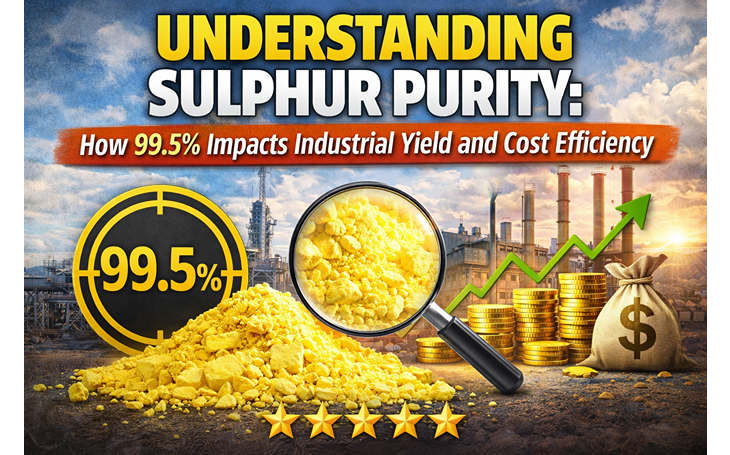
Understanding Sulphur Purity: How 99.5 percent Impacts Industrial Yield and Cost Efficiency
Sulphur is not only a commodity. It is a precision ingredient. Manufacturers in fertilizers, chemicals and rubber industries do not simply buy sulphur by weight. They buy it for its purity. A purity level of 99.5 percent is widely considered the global industry benchmark. When a shipment falls below that standard, everything in the production chain starts to become unpredictable.
Understanding why purity matters helps industrial buyers make smarter decisions and avoid expensive production challenges.
Why Purity Is More Important Than Price
Sulphur behaves differently depending on its chemical content. High purity sulphur melts consistently, reacts as expected and produces fewer by-products. Low purity sulphur often contains minerals or moisture that disrupt reactions.
The cost of impurities shows up in several areas. Plants consume more energy, need higher process temperatures or require chemical corrections. Some processes slow down, while others fail to reach target yield. Even a one percent purity difference can change how a production plant uses inputs, fuel and time.
For large manufacturers, these inefficiencies scale into millions of rupees in annual operating cost.
Fertilizer Conversion Efficiency
Fertilizer producers depend on sulphur to create sulphuric acid. Acid then becomes a base input for phosphate fertilizers. Phosphate plants measure success by acid conversion yield. High purity inputs give better conversion rates with fewer contaminants in the final product.
Imagine feeding sulphur with 95 percent purity into the same process. The remaining 5 percent is waste. This waste must be removed, neutralized or burned off. The plant will consume more energy, and the quality of fertilizer will drop. Granules may harden differently, storage stability may weaken and nutrient delivery becomes inconsistent.
Fertilizer manufacturers work on tight margins. Every reduction in conversion efficiency directly impacts profits. This is why large producers insist on refinery grade 99.5 percent sulphur.
Rubber Vulcanization and Product Stability
Rubber processing is even more sensitive. Vulcanization is a reaction that strengthens rubber by forming bonds. Sulphur purity controls how uniform these bonds are. A high purity sulphur allows rubber to cure evenly, giving predictable durability and elasticity.
If the sulphur contains ash or mineral impurities, microscopic defects form in the rubber. These defects reduce tensile strength. Tires, industrial seals and conveyor belts lose performance. When production cycles run at large volumes, manufacturers may see entire batches rejected.
Rubber factories do not experiment with cheap inputs. They prefer reliable sulphur grades because the cost of defective products is far higher than the cost of premium raw material.
Aerospace, Electrochemistry and High End Uses
Industries that work with specialized chemicals have even larger risk exposure. Electrochemical processes, certain plastics and specialty resins need stable sulphur to maintain consistency in reaction temperatures and pH levels. A small impurity creates chain reactions and affects downstream materials.
In these sectors, purity is not a luxury. It is a safety requirement.
How Purity Reduces Hidden Costs
Many procurement teams focus on unit price. The true cost is calculated in production hours, waste removal, energy consumption, downstream rejects and storage maintenance.
High purity sulphur keeps equipment cleaner. It reduces corrosion, prevents unwanted deposits and lowers maintenance downtime. When plants run without unplanned disruptions, they benefit from steady revenue and predictable delivery schedules.
This is also why many businesses prefer sulphur balls. Their spherical form creates less dust, packs efficiently and resists contamination. Better handling equals lower operational risk.
Verifying Purity Before Shipment
Responsible exporters do not rely only on supplier claims. They verify product quality through independent labs like SGS or Intertek. They test moisture content, ash percentage, sulphur concentration and particle consistency. Buyers receive reports before shipment leaves the port.
Full documentation, including MSDS, packaging specification and Q and Q inspection, helps industrial clients plan storage and production. This eliminates surprises at the receiving end.
Final Thoughts
Raw sulphur purity is more than a technical specification. It shapes productivity, safety and profitability. Manufacturers who invest in high grade 99.5 percent sulphur gain long term benefits that exceed the price difference at purchase. Understanding this relationship allows procurement teams to secure stable output, reduce waste and maintain high performance across industrial processes.
Get more insights on Gsinfotechvis.
Check us out on LinkedIn.