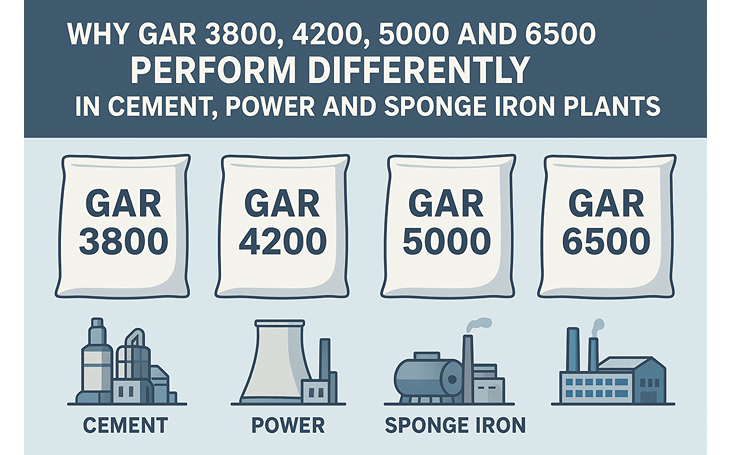
Why GAR 3800, 4200, 5000 and 6500 Perform Differently in Cement, Power and Sponge Iron Plants
Coal selection in industry is not about buying the highest calorific value. Different plants use coal for different technical purposes. Cement kilns, power boilers and sponge iron furnaces behave differently when fuel energy changes. Understanding how GAR 3800, 4200, 5000 and 6500 perform allows purchasing heads to build a decision framework that supports long term process stability.
The Meaning Behind GAR Values
GAR refers to Gross As Received. It represents the energy available in coal including inherent moisture. Higher GAR coal burns hotter and produces more heat per kilogram. But that does not automatically make it the best option. Equipment design, flame stability, ash handling and fuel cost per kcal all matter.
Industrial coal buyers who succeed are the ones who view GAR like raw material grade. Each grade suits a specific machine and production method.
GAR 3800 in Cement Plants
Cement manufacturers often prefer lower GAR coal such as 3600 to 4200. The reason is simple. Cement kilns need steady flame rather than extreme temperature spikes. Lower GAR coal burns slower and provides stable thermal continuity. It allows clinker to form evenly in the rotary kiln.
GAR 3800 is cheaper per ton and works well when the kiln has strong preheater systems or multi stage cyclones. It helps maintain kiln residence time and prevents overburning. Fuel consumption by weight may be higher, but cement plants recover that cost through stable clinker formation and lower refractory stress.
Choosing GAR 3800 is a strategic operational decision. It prioritizes controlled heat release rather than aggressive heating.
GAR 4200 for Industrial Boilers
Boilers in small to mid sized industrial units often rely on GAR 4200 coal. It is a balance grade. It provides stronger heat than 3800 without the cost pressure of high GAR coal.
Factories that generate steam for textiles, food processing, chemicals or paper mills typically select GAR 4200 because it fits their burner efficiencies. They do not need extreme temperature gains. They need manageable combustion curves, predictable ash discharge and fewer flame fluctuations.
GAR 4200 has better response in load variation and does not shock boiler tubes with sudden thermal stress. This grade is about reliability and safe operating margins.
GAR 5000 for Power Plants
Power plants are designed to convert heat to electricity. They benefit from higher GAR coal because steam turbines require strong and sustained heat. GAR 5000 delivers more energy per kilogram, which means less coal volume per megawatt.
Higher GAR coal reduces conveyor load, improves coal to power conversion and minimizes unburnt carbon. It also reduces the maintenance burden on ash handling systems. The economic advantage shows up in fuel cost per unit of power produced.
Many power plants calibrate their boilers for GAR 4800 to 5200. Anything below may reduce generation potential. Anything significantly above may disrupt burner design if equipment is not sized for rapid heat release. The sweet spot is usually in the mid to high 4000s or low 5000s.
GAR 6500 for Sponge Iron Plants
Sponge iron production is very sensitive to coal chemistry. Coal is not used only as fuel. It acts as reductant, removing oxygen from iron ore inside rotary kilns. This reaction needs high fixed carbon and stable heat.
GAR 6500 coal provides strong calorific value and supports reduction without compromising on carbon availability. It maintains kiln temperature in the 1000 to 1100 degree range. Lower GAR coal may fail to sustain reduction, leading to incomplete metallization and wasted ore.
Sponge iron plants often spend more on fuel because they are buying chemistry, not just energy. This is why GAR 6500 or equivalent high calorific coal is preferred.
A Simple Decision Framework
Instead of asking which GAR is cheapest, ask which GAR protects your production:
◾ Cement kilns need stability.
◾ Industrial boilers need balance.
◾ Power plants need high thermal yield.
◾ Sponge iron plants need energy plus carbon strength.
Coal is not a universal commodity. Each GAR grade serves a different industrial logic. Purchase decisions that match plant design prevent operational risk.
Final Thought
Coal performance is defined by application, not just calorific value. GAR 3800, 4200, 5000 and 6500 behave differently because industrial processes consume heat in different ways. Buyers who link fuel specifications to end use achieve higher efficiency and lower long term cost. This is how reliable coal supply becomes a competitive advantage. Get more insights on
Gsinfotechvis.
Follow us on
LinkedIn.