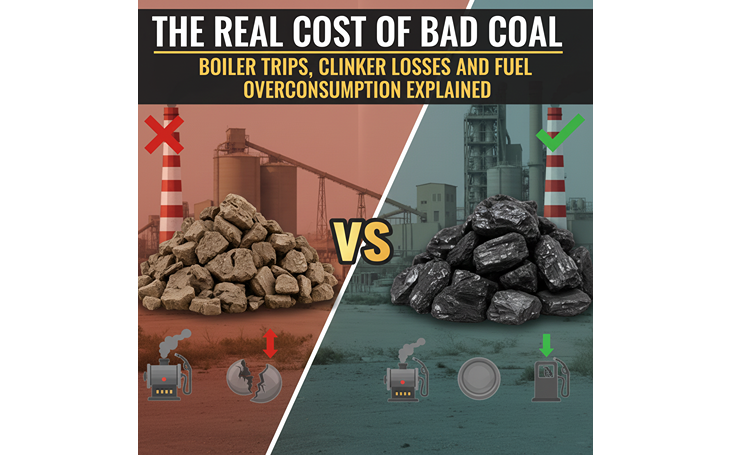
The Real Cost of Bad Coal: Boiler Trips, Clinker Losses and Fuel Overconsumption Explained
Many buyers look at coal as a number on a spreadsheet. They see a lower price per tonne and assume they are saving money. But in power plants, cement factories and sponge iron units, coal quality is not a cosmetic feature. It directly controls combustion stability, equipment life and output. Cheap coal often becomes the most expensive purchase you will ever make. The real cost is not in the invoice. It is in lost production, repairs and wasted fuel.
Let’s break down how poor coal quality silently destroys industrial performance.
How bad coal triggers boiler trips
Boilers depend on steady heat to produce steam. When coal has unpredictable moisture, volatile matter or unstable ash chemistry, combustion becomes erratic. Flame intensity fluctuates. Steam load swings. Sensors detect unsafe variation and the control system initiates a shutdown.
Every boiler trip costs:
◾ Time lost during cool down
◾ Restart energy consumption
◾ Sudden thermal shock to tubes and headers
◾ Safety inspections and compliance delays
In coal-fired plants, even a single trip can disrupt generation schedules. Frequent trips force operators to burn additional fuel simply to maintain baseline output.
Moisture and fines create runaway fuel consumption
Low-quality coal often carries excessive moisture. Before combustion begins, energy must evaporate this water. That energy is stolen from the furnace, forcing operators to increase feed rates to compensate.
The consequences:
◾ Higher coal flow rate
◾ Reduced boiler efficiency
◾ Excess airflow to stabilize flame
◾ Accelerated wear on mills and feeders
Coal that appears cheaper at purchase ends up costing more per megawatt or per tonne of finished product. Moisture also increases degradation during transport. As coal tumbles, it breaks into fines. Fines ignite rapidly and unevenly, producing short, aggressive heat bursts that destabilize furnace operation.
Clinker formation ruins kilns and reduces throughput
Cement kilns and sponge iron rotary kilns suffer when coal ash melts prematurely. Ash fusion temperature determines when ash softens and begins sticking to hot surfaces. Low-fusion ash forms coatings on kiln walls. These coatings trap additional particles and grow into dense clinker deposits.
Clinker causes:
◾ Blocked kiln passages
◾ Uneven heat transfer
◾ Material flow choking
◾ Burnt refractory lining
◾ Forced shutdowns for deposit removal
Clinker removal is not routine cleaning. It requires manpower, mechanical intervention and costly downtime. A kiln designed for continuous operation is forced to stop mid-cycle, wasting fuel and raw material.
Fouling and slagging in industrial boilers
In boilers, slagging occurs when molten ash adheres to high-temperature surfaces. Fouling occurs when cooler downstream surfaces trap airborne ash. Both conditions reduce heat transfer and raise exhaust temperatures, pushing operators to burn more fuel to reach target steam production.
If fouling spreads to superheater bundles or heat exchangers, shutdown becomes unavoidable. In severe cases, slag accumulation requires section replacement. Repair expenses can easily exceed any savings gained from buying cheaper coal.
Bad coal shortens equipment life
Industrial systems are engineered to tolerate stress, not instability. Uneven combustion introduces repeated thermal shock to furnace walls, boiler tubes, cyclones and burners. Maintenance teams spend significant resources correcting problems caused entirely by inconsistent fuel.
Typical impacts:
◾ Tube leaks from rapid temperature variation
◾ Fan overload due to unstable air-fuel ratios
◾ Damaged kiln refractory
◾ Coal mill vibration from excessive fines
◾ Conveyor abrasion and material spillage
Plants operating on low-grade fuel replace components more frequently. This is not operational complexity. It is avoidable wear driven by poor procurement choices.
Production losses are more expensive than coal
Consider a 100 MW boiler tripping during peak demand. A cement kiln shutting down mid-batch. A sponge iron plant losing metallization due to falling temperatures. These failures extend beyond equipment damage. They delay deliveries, disrupt contracts and weaken customer trust.
Hidden costs accumulate quickly:
◾ Unplanned overtime
◾ Idle manpower
◾ Contract penalties
◾ Emergency fuel purchases
◾ Lost output revenue
A shipment priced seven percent cheaper can ultimately cost twenty-five percent more when evaluated against real operating impact.
Why procurement discipline beats bargain hunting
Industrial fuel procurement is not about securing the lowest invoice. It is about minimizing total operating cost. Buyers who focus solely on calorific value overlook ash chemistry, moisture content, particle size distribution and fusion temperatures. Reliable suppliers deliver coal that performs consistently across shipments.
A disciplined buyer verifies:
◾ GAR suitability for furnace demand
◾ Ash fusion temperature and composition
◾ Moisture percentage at loading
◾ Volatile matter range
◾ Third-party inspection certification
◾ Bulk handling and transport integrity
Working with a trusted supply partner reduces operational risk far more effectively than chasing short-term discounts.
How Gsinfotechvis protects buyers from bad coal
Gsinfotechvis Pvt Ltd supplies coal based on operational performance, not just paper specifications. The company sources from vetted mines and verifies ash chemistry, fusion temperature and moisture levels before cargo dispatch. Buyers receive fuel matched to their furnace, kiln or boiler requirements.
Clients benefit from:
◾ Consistent calorific ranges aligned to application
◾ Stable ash behavior that prevents clinker and slagging
◾ Moisture-controlled shipments that reduce overconsumption
◾ Port and logistics planning to prevent handling damage
◾ Complete documentation and inspection support
The cheapest coal is rarely the most economical choice. If you want predictable output, fewer shutdowns and longer equipment life, Gsinfotechvis helps you secure fuel engineered for real industrial performance.
Follow us on LinkedIn.