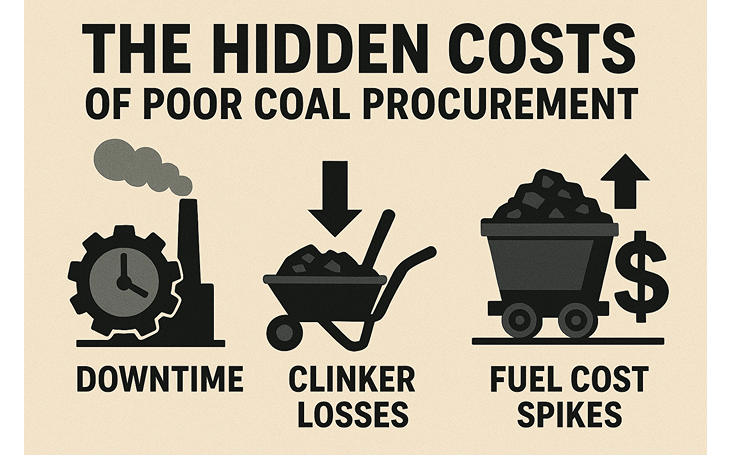
The Hidden Costs of Poor Coal Procurement: Downtime, Clinker Losses and Fuel Cost Spikes
Industrial coal buying is often reduced to a simple number. Buyers compare per ton prices, negotiate a discount, and sign a supply contract. But poor procurement decisions do not show their consequences immediately. They arrive later inside the factory. They appear in boiler inefficiency, unstable furnaces, clinker losses and unscheduled shutdowns. The hidden costs of poor coal procurement are far higher than any price advantage on paper.
Downtime Is the Cost Nobody Wants to Pay
When coal quality does not match operational standards, production continuity suffers. Boilers may fail to maintain pressure, kilns may cool abruptly and furnaces may drop below critical thresholds. Every interruption comes with a price. Restarting heavy industrial equipment requires labour, calibration and sometimes fresh material input.
Downtime is not just a pause. It disrupts delivery schedules, order commitments and energy output. Power plants may lose megawatts of capacity for every hour. Cement plants may lose entire kiln cycles. Steel mills may lose furnace heat profiles and have to recondition their hearths. The expense becomes visible in manpower overtime, reduced yield and inefficient restart cycles.
Procurement heads who treat coal as a low risk commodity often encounter this problem. A single cheap shipment with unstable moisture or inconsistent calorific value can trigger a chain of disruptions that cost many times more than the savings achieved.
Clinker Losses in Cement Plants
Cement factories are highly sensitive to coal quality. Rotary kilns require stable thermal conditions to form clinker. When coal fluctuates in GAR or NAR value, the kiln flame becomes inconsistent. Clinker may become under burnt or over burnt. In both cases, quality drops. Grinding becomes more energy intensive and the resulting cement has uneven strength.
Clinker loss is not a theoretical risk. It is a daily operational reality. Each ton of coal that burns short of expected energy forces the kiln to run harder or longer. More heat is pushed into the chamber to compensate. This increases fuel consumption and damages lining materials. Refractory wear accelerates and maintenance intervals shrink.
A procurement team that did not verify moisture, ash or calorific stability often ends up paying these costs quietly. They may not link the issue back to coal because the effects appear inside the process. Yet the source of the problem is poor fuel consistency.
Fuel Cost Spikes When Quality Drops
Industrial operators often calculate coal expense in per ton terms. A much better metric is cost per kcal delivered to the plant. When coal has unstable energy content, the actual calorific yield falls. Operators have to burn more coal to reach the same output. Fuel bills grow even if the supplier charged a lower rate initially.
Moisture is a major factor. Wet coal consumes energy to evaporate water before combustion begins. Ash is another. High ash coal produces non combustible residue that increases disposal costs and reduces heat transfer. Excess sulfur may create corrosion or pollution penalties. Each of these parameters is measurable, but only if tested and verified.
Reliable procurement is not about finding the cheapest coal. It is about securing predictable energy units. Industrial buyers who choose stable coal achieve lower total fuel spend across months, not just in the invoice cycle.
Why Downstream Consequences Stay Hidden
Procurement happens at the desk. Combustion happens inside machines. The two departments often do not communicate closely. A purchasing head sees stable supply volumes and a competitive price. The operations team sees fluctuating heat, clinker failures and rising maintenance. Unless the factory tracks performance against coal quality data, no one connects the dots.
This disconnect makes bad procurement decisions appear harmless. The supply continues. Payments continue. Meanwhile production suffers silently. A trusted supplier who maintains coal consistency prevents these inefficiencies before they start. That is why companies like
Gsinfotechvis
focus on specification control, verified sourcing and strong inspection protocols.
Final Thought
Poor coal procurement does not show its cost at the negotiation table. It reveals itself inside boilers, kilns and furnaces. It appears as downtime, clinker loss, performance dips and fuel spikes. For industrial users, choosing the right coal is not an accounting exercise. It is a strategic decision that protects output, quality and profitability. Good procurement prevents operational failures that cheap coal creates.
Know more about us on
LinkedIn.