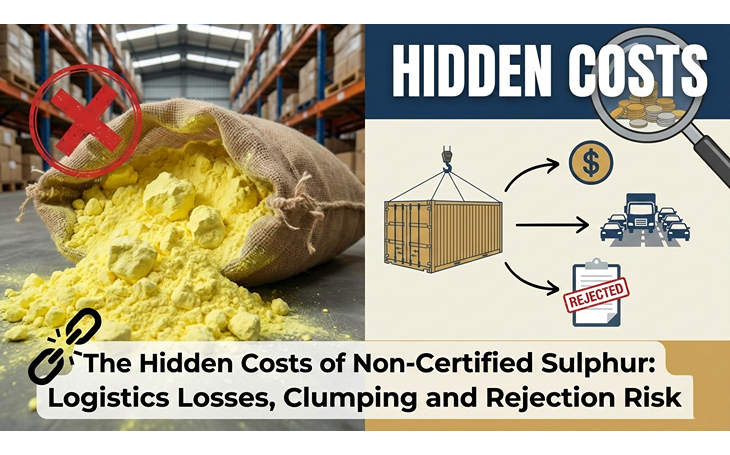
The Hidden Costs of Non-Certified Sulphur: Logistics Losses, Clumping and Rejection Risks
In bulk commodity trading, price is not the only metric that matters. Many buyers choose cheaper sulphur sources hoping to cut procurement expenses. What they actually get is product that looks fine on paper but causes hidden losses from the moment it is loaded. Non-certified raw sulphur often arrives with moisture, dust, contamination or inconsistent particle size. These defects cause clumping, storage failures, rejected cargo and operational headaches that quietly kill margins.
Understanding these risks helps industrial buyers protect their production lines and avoid costly mistakes.
Moisture Is the First Silent Threat
Sulphur attracts humidity. Even small moisture levels in non-certified batches start forming sticky layers. This moisture mixes with dust and impurities, creating a soft surface that binds together into large lumps. The longer sulphur sits in a warehouse or port yard, the worse the clumping becomes.
Moisture impacts every stage:
◾ Slow unloading at ports
◾ Higher labor and equipment use
◾ Excessive breakage of sulphur particles
◾ Inaccurate weight readings
◾ Poor melting performance in sulphur burners
When sulphur must be crushed, milled or heat-treated before use, energy consumption climbs and handling time increases. What looks like a discounted purchase becomes an expensive raw material.
Contamination Is More Than a Quality Issue
Non-certified sulphur can contain ash, sand, chemical residues and organic matter. These contaminants change how the sulphur behaves during melting or chemical conversion. In fertilizer plants, impurities disrupt sulphuric acid production. In rubber vulcanization, contamination weakens crosslinks. In petrochemical processes, catalyst life is reduced.
The real problem is inconsistency. A contaminated shipment can still show acceptable sulphur content on a basic specification sheet, but its impurities vary from truck to truck. As a result, production batches behave unpredictably. Downtime increases, operators lose confidence and maintenance cycles become more frequent.
Bulk Handling Losses Multiply Over the Supply Chain
Non-certified sulphur is often poorly formed. Balls break, fines accumulate and product grinds into powder during transit. In the sulphur trade, every percentage of dust represents real money lost. Dust also increases risk of ignition and safety violations.
Typical bulk handling losses appear at:
◾ Loading conveyor systems
◾ Vessel storage holds
◾ Port discharge
◾ Warehouse stockpiles
◾ Bagging and repacking operations
Losses of two to five percent are common with non-certified sulphur. On large industrial shipments, this can mean hundreds of tonnes disappearing from the books. Buyers pay freight, inspection and customs duties for material that never becomes usable feedstock.
Clumping Can Destroy an Entire Shipment
When sulphur absorbs moisture and heats under pressure, its particles fuse into rock-like masses. These blocks can be so hard that unloading equipment cannot break them. Ports must bring excavators, bulldozers or specialized hammer systems to unload cargo. Each extra hour creates demurrage charges and vessel penalties.
The operational dangers include:
◾ Damage to conveyor belts
◾ Overloaded cranes
◾ Worker safety risks
◾ Wasted loading equipment hours
Many ports simply reject clumped cargo. Once rejected, the buyer pays for storage, re-bagging or disposal. The initial price discount becomes meaningless.
Rejection Risk Is the Most Expensive Outcome
Every serious buyer understands one truth. A shipment that fails quality inspection is worse than no shipment at all. Fueling plants, fertilizer factories and chemical facilities operate on schedules. Missed feedstock deadlines force output cuts or plant stoppages. Rejected sulphur can trigger legal disputes, insurance claims and penalties.
Rejection happens when:
◾ Particle breakdown produces excess fines
◾ Moisture surpasses allowed tolerance
◾ Export documentation does not meet MSDS requirements
◾ Hazard labeling violates port safety rules
◾ Physical contamination is visible during discharge
Some shipments get rejected by customs before unloading begins. Buyers still pay freight and cannot recover operational time.
Why Certified Sulphur Protects Your Business
Certified sulphur undergoes quality documentation, third party testing and batch inspection. Material is checked for particle size, moisture content, ash percentage and safety compliance. The product is packaged and stored to reduce clumping. Handling protocols are designed to keep the sulphur stable until it reaches industrial plants.
Certified supply leads to:
◾ Higher usable yield
◾ Smooth unloading and storage
◾ Consistent melting in sulphur burners
◾ Predictable chemical performance
◾ Real control over lifecycle costs
The initial price may be higher, but the total cost of ownership is significantly lower.
How Gsinfotechvis Prevents Hidden Losses
Gsinfotechvis Pvt Ltd supplies refinery-grade raw sulphur from vetted producers. Each shipment carries laboratory verification, MSDS documentation and export compliance. The company avoids agro-grade or derivative sulphur, which often carries moisture or inconsistent purity.
Clients benefit from:
◾ Stable cargo that resists clumping
◾ Accurate packaging and containerization
◾ Third party inspections for quality and weight
◾ Efficient logistics to reduce demurrage
◾ Dedicated support for documentation and customs
A reliable sulphur partner saves more money than a cheap supplier. In a market where every tonne matters, Gsinfotechvis ensures buyers receive actual usable sulphur, not costly surprises. If your business depends on stable supply and predictable performance, working with Gsinfotechvis helps protect your production and your margins.
Check us out on LinkedIn.