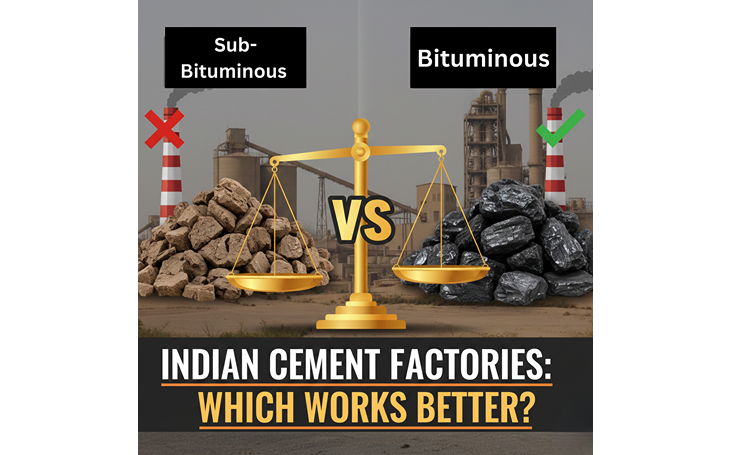
Sub-Bituminous vs Bituminous Coal: Which Works Better for Indian Cement Factories?
Cement manufacturing is a fuel-intensive industry. The rotary kiln that drives the calcination process must run at extreme temperatures for long periods. Coal selection determines how stable those temperatures stay, how clean the kiln operates and how much clinker a plant produces per hour. In India, most factories choose between sub-bituminous and bituminous coal. Both types burn differently, behave differently and impact equipment life differently.
Understanding these differences helps cement buyers avoid costly kiln shutdowns and unplanned maintenance.
Coal types and their basic characteristics
Coal classification depends on carbon concentration, moisture and volatile matter. As coal matures geologically, it shifts from lignite to sub-bituminous, then to bituminous and eventually anthracite.
Sub-bituminous
◾ Moderate energy content
◾ Higher moisture
◾ Lower ash fusion risk
◾ More stable, gentler flame
◾ Usually cheaper per tonne
Bituminous
◾ Higher calorific value
◾ Lower inherent moisture
◾ Higher volatile matter
◾ Hotter and more responsive flame
◾ More sensitive to ash chemistry
Both fuels can run cement kilns, but they do not deliver the same operating performance.
Why cement kilns have specific fuel requirements
Cement kilns operate around 1400 to 1500 degrees Celsius in the sintering zone. Below, pre-calciner and preheater zones have different thermal profiles. A stable flame and uniform heating are essential to avoid ring formation, clinker quality issues and refractory damage.
Fuel influences:
◾ Kiln temperature stability
◾ Rate of heat transfer to the clinker bed
◾ Ash buildup on kiln walls
◾ Exhaust gas chemistry
◾ Burner momentum and swirl
Cement plants do not care only about calorific value. They care about how coal burns over the length of the kiln.
Sub-bituminous coal: steady, forgiving and efficient for long cycles
Sub-bituminous coal burns moderately and produces less localized overheating. In cement plants, this means smoother heat distribution across the kiln and fewer thermal shocks.
Advantages in practice:
◾ Lower ash fusion risk reduces ring formation
◾ Moisture moderates combustion intensity
◾ Reduced clinker melt overdrive
◾ More uniform flame envelope
Because of its more controlled combustion, sub-bituminous coal is ideal for factories that prioritize long operational stretches over peak thermal response.
Common use cases:
◾ Plants with older kiln linings
◾ Locations with long raw meal residence time
◾ Facilities where slagging has been a recurring issue
Its biggest drawback is higher fuel feed rate. Plants may need to burn more tonnes to reach target heat load.
Bituminous coal: higher output, sharper flame, more risk
Bituminous coal offers higher energy per tonne and a stronger thermal profile. This is why many high-capacity cement kilns use it as their primary fuel. When tuned correctly, bituminous coal improves clinker burning zone efficiency.
Advantages:
◾ Stronger flame momentum
◾ Faster material heating
◾ Better kiln response to fluctuations
◾ Lower moisture loss overhead
However, bituminous ash chemistry is unstable. Iron and alkali content can lower ash fusion temperature. This triggers slagging, thick kiln rings and clinker balls that choke the discharge zone.
Plants switching to bituminous without adjusting burner settings often see:
◾ Rapid clinker coating
◾ Overheated sintering zone
◾ Refractory wear
◾ Frequent descaling shutdowns
High energy coal rewards experienced process engineers, not casual buyers.
Indian market trends and procurement logic
Indian cement factories operate under cost pressure. Fuel accounts for up to 30 percent of clinker production cost. Many procurement teams chase lower landed fuel price without considering kiln performance. The result is predictable. Cheap coal leads to frequent shutdowns, higher maintenance and lower clinker output.
Current trend:
◾ Sub-bituminous coal is preferred in central and southern India
◾ Bituminous coal is favored in high throughput northern units
◾ Blended fuel strategies are rising to control ash problems
Imported Indonesian sub-bituminous coal remains popular due to stable properties. Bituminous coal from Australia, South Africa or Mozambique is used where plants have strong burner control and refractory budget.
Matching coal type to plant maturity
Newer kilns with efficient coolers, pre-heaters and burner systems often perform well with bituminous coal. Older or sensitive kilns benefit from the softer flame profile of sub-bituminous coal. Plants in transition use blends to balance ash chemistry with thermal demand.
Decision checklist:
◾ What is your target kiln temperature profile?
◾ How frequently do you manage ring formation?
◾ What is your ash removal budget?
◾ How experienced is your combustion team?
◾ Do you have lab support for ash fusion and VM testing?
Fuel choice should be a technical decision, not a price gamble.
How Gsinfotechvis simplifies coal procurement for cement factories
Gsinfotechvis Pvt Ltd understands the operational reality of cement plants. The company does not push random coal grades. Instead, it sources coal that matches furnace design, kiln size and clinker chemistry requirements. Each shipment is supported by moisture, ash and calorific profiles, so factories know exactly how their fuel will perform.
Clients benefit from:
◾ Coal graded for kiln safety, not just price
◾ Transparent ash fusion and VM data
◾ Moisture-controlled supply to prevent flame instability
◾ Logistics planning to avoid port and rail delays
◾ Support on Incoterms and charter party terms
Whether your factory needs steady 5200 to 5600 GAR sub-bituminous or higher GAR bituminous for fast throughput, Gsinfotechvis provides coal engineered for real cement production, not laboratory numbers.
Fuel is not just energy. It is the heartbeat of a cement kiln. Choosing the right coal determines how smoothly your plant runs and how profitable it becomes.
Follow us on LinkedIn.