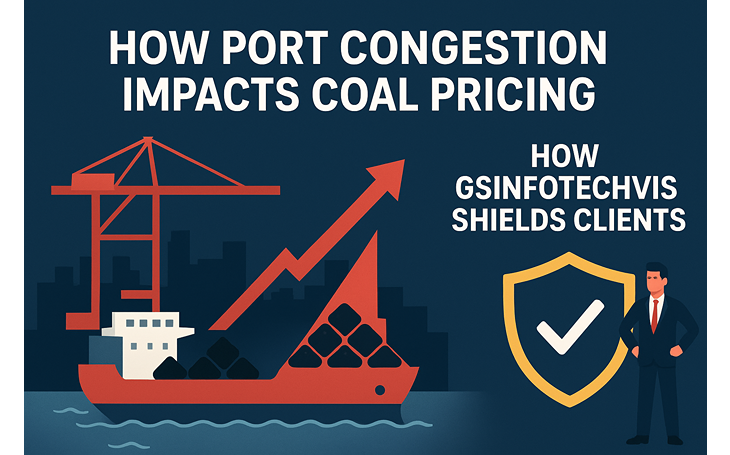
How Port Congestion Impacts Coal Pricing and How Gsinfotechvis Shields Clients
Coal buyers often assume pricing is driven mainly by calorific value, market index or origin. In reality, one invisible force changes the cost of every shipment: port congestion. When vessels wait to berth, discharge or clear customs, the entire supply chain gets more expensive. Fuel consumption increases, demurrage charges grow and freight markets tighten. Buyers end up paying more per tonne even if the coal grade remains unchanged.
Understanding this relationship is essential. Markets are unpredictable, but logistics patterns are measurable. Those who grasp the link between congestion and price protect their budgets and avoid costly surprises.
Why Congestion Matters More Than Most Buyers Expect
Port congestion is not just a delay issue. It is a multiplier. When dozens of vessels wait offshore, it forces traders, operators and miners to slow exports.
Shipowners raise freight rates to compensate for idle time. Traders push premium pricing to cover the risk. When this becomes systemic, buyers pay more even if the market index stays neutral.
Coal is a bulk commodity with tight margins. Every day of delay changes total cost. In many cases, demurrage at busy ports is not an exception. It is a normal operating condition. Buyers who do not factor it in end up shocked when invoices land.
APAC Supply Hubs Feel Pressure First
Asia Pacific ports handle most of the world’s coal volumes. Indonesia, Australia and South Africa serve India, Vietnam, China and the Middle East. When seasonal peaks hit, bottlenecks form at load ports and discharge ports.
In Indonesia, small terminals and shallow draft routes cause queuing during monsoon or export rush seasons.
In India, congestion occurs at major power and industrial gateways where customs and berth slots compete with agricultural imports and general cargo.
In Vietnam and Thailand, discharge capacity is limited, and coal shipments often compete with fertilizer, grain and refined fuel vessels.
This means congestion is not an accident. It is structural. If buyers do not build contracts around it, pricing becomes unstable.
The Real Cost Driver: Demurrage
Demurrage is a penalty paid to the shipowner when loading or unloading exceeds the agreed time. It sounds administrative, but it is significant in scale.
A capesize or supramax vessel can accumulate tens of thousands of dollars per day. A slow terminal or a late clearance can multiply these costs quickly.
Traders will not absorb this alone. They pass it on to the coal price. Buyers get the invoice even if they were not responsible for the delay. This is why poorly structured deals can turn profitable coal into loss making cargo.
How Contracting Turns Congestion Into a Buyer Problem
Most first time or inexperienced buyers accept supplier friendly contracts. These agreements usually:
◾ Ignore real port performance
◾ Do not specify laytime
◾ Lack anti demurrage clauses
◾ Do not allocate fault clearly
◾ Push all delay risk to the buyer
When a vessel sits at anchorage for three days because customs is backlogged, the buyer absorbs the cost. When heavy rain prevents loading, the buyer pays. When a terminal changes berth assignment, the buyer waits.
At the contract stage, these scenarios feel abstract. At the port, they become expensive reality.
How Gsinfotechvis Shields Clients from Congestion Risk
Gsinfotechvis approaches congestion as a predictable operational factor, not an occasional inconvenience. Protection begins at negotiation, not after discharge.
1. Real laytime benchmarking
Contracts are built using actual historical discharge and loading speeds. We analyze port capacity, crane productivity and seasonal slowdown. This avoids unrealistic time allowances that trap buyers in demurrage fees.
2. Anti demurrage enforcement
If delays stem from the supplier’s side, such as incomplete documentation, delayed cargo arrival or port misalignment, we lock cost responsibility with the supplier, not the buyer.
3. Shipment sequencing and routing strategy
We do not just pick the nearest port. We select gateways based on efficiency, clearance speed and storage options. When congestion spikes at one terminal, alternative discharge routes activate before delays escalate.
4. Documentation readiness
The fastest vessel can still stall if paperwork is wrong. We make sure MSDS, hazardous declarations, cargo manifests and inspection certificates are complete before departure. This prevents customs induced queues that many traders ignore.
The Bottom Line for Industrial Buyers
Coal markets will always fluctuate. Port congestion will never disappear. What buyers can control is how risk is distributed.
Those who treat logistics as a cost center pay more than they should.
Those who treat logistics as a contractual weapon avoid hidden charges and protect profitability.
A well structured supply strategy does not chase the cheapest tonne. It secures predictable delivery, accurate paperwork and fair risk allocation. That is how coal buyers stay competitive even when ports are full and vessels queue on the horizon.
Know more about us on LinkedIn.