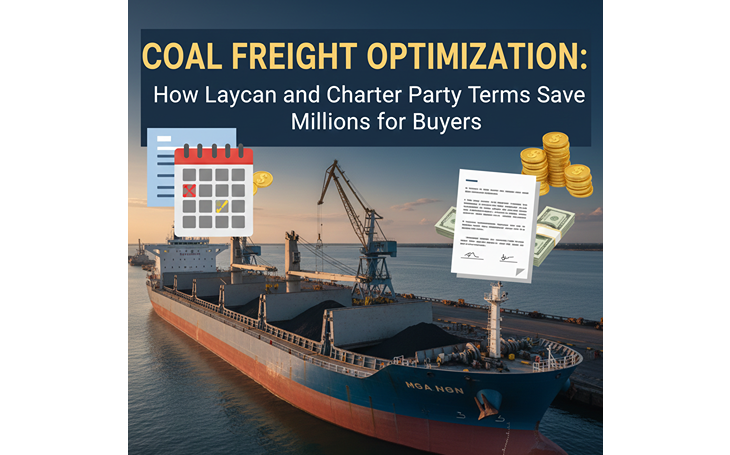
Coal Freight Optimization: How Laycan and Charter Party Terms Save Millions for Buyers
Coal trading is not just about buying tonnes. It is about moving them across oceans without losing money in waiting time, contract disputes or vessel penalties. This is why the most successful coal buyers master shipping concepts such as laycan and charter party terms. Even a small improvement in freight planning can save millions over the course of a year. Poor planning, on the other hand, can turn profitable cargo into a financial disaster.
Coal is a bulk commodity. Freight cost can be higher than the fuel itself. Understanding logistics and contract language is as important as knowing calorific value or ash percentage.
What is laycan and why it matters
Laycan stands for laydays and cancelling date. It defines the time window in which a vessel must arrive to load or discharge cargo. If a vessel shows up before the window, the port may not accept it. If it arrives after, the charterer can cancel the contract or renegotiate the price.
In simple terms:
◾ Laydays = earliest date vessel can arrive
◾ Cancelling = latest date vessel must arrive
A poorly planned laycan causes panic. Mines delay loading, buyers rush to find replacement vessels, and the clock runs against both parties. Meanwhile, demurrage charges begin accumulating.
When coal volume exceeds storage or loading capacity, port management becomes unpredictable. A well-defined laycan protects both sides from chaos.
Why laycan optimization saves real money
Coal supply chains run through busy export terminals with limited loaders and berths. If your vessel arrives on time but another cargo is ahead of schedule, you wait. Every hour of waiting is a cost, not a number on paper.
Typical outcomes of poor laycan decisions:
◾ Vessel idle at anchorage
◾ Port storage backlog
◾ Emergency re-routing
◾ Crew overtime
◾ Contract penalties
Experienced buyers do not gamble with laycan. They synchronize port availability, rail delivery from the mine and vessel positioning. This reduces idle time and prevents last-minute bottlenecks.
Charter party terms: the fine print that matters
The charter party is the contract between ship owner and charterer. In coal trading, it governs everything from cargo handling to what happens when weather stops operations. Buyers who overlook charter terms end up paying for someone else’s mistakes.
Core charter party elements:
◾ Laytime (loading or unloading hours)
◾ Demurrage and despatch rates
◾ Cargo handling responsibilities
◾ Weather interruption clauses
◾ Port congestion rules
◾ Safety and hazard protocols
Every clause turns into real cost during real delays. If storms close a port and the contract treats weather as charterer risk, the buyer pays demurrage. If coal dust violates terminal safety, unloading may halt and the buyer absorbs port storage fees.
A strong charter party anticipates conditions. It assigns risk fairly and protects the buyer from unforeseen events.
Demurrage: the silent freight killer
Demurrage is the penalty paid for exceeding laytime. It is calculated daily and can exceed tens of thousands of dollars per day. Long delays due to port congestion or documentation issues can wipe out the profit margin of an entire shipment.
Typical causes:
◾ Loading queues at export terminal
◾ Moisture rejections or cargo clumping
◾ Customs clearance errors
◾ Unbalanced charter terms
◾ Late vessel arrival or early berth shortage
Importers often underestimate demurrage risk. They assume rates are industry standard when, in reality, every port has different timelines and crane limitations.
Smart businesses do two things:
◾ Avoid demurrage through better planning
◾ Negotiate despatch bonuses when cargo is loaded early
Despatch is the opposite of demurrage. It rewards fast operation. When structured correctly, buyers can turn time efficiency into a financial advantage.
The role of Incoterms in coal freight
Incoterms do not define quality or price. They define responsibility. In coal trade, the wrong Incoterm shifts logistics failures onto the buyer.
Examples:
◾ FOB: Buyer handles freight and insurance once cargo crosses ship rail
◾ CIF: Seller manages freight and insurance, buyer handles destination port
◾ CFR: Freight handled by seller, insurance falls on buyer
If a buyer selects FOB without knowing berth congestion patterns, they may absorb demurrage and storage fees. If they choose CIF but do not verify insurance coverage, moisture and clumping become their risk.
Incoterms must match operational capability, not wishful thinking.
Practical tips to optimize freight cost
Operational discipline beats negotiation bravado. Buyers who follow structured protocols protect margins in volatile markets.
Key practices:
◾ Align laycan with realistic loading windows
◾ Track vessel ETA against port congestion reports
◾ Use performance data from past charters
◾ Confirm rail delivery timelines at origin
◾ Verify coal moisture before loading to avoid port rejection
◾ Assign clear demurrage rules in the charter
Freight planning is cheaper than freight firefighting.
How Gsinfotechvis reduces freight risk for coal buyers
Gsinfotechvis Pvt Ltd does not view coal trading as a single transaction. The company treats logistics as performance engineering. Every shipment is mapped to rail availability, port schedules and contract terms. This reduces waiting time and prevents demurrage surprises.
Clients benefit from:
◾ Transparent laycan planning
◾ Charter party consulting
◾ Verified moisture and cargo documentation
◾ Port handling strategies to avoid congestion
◾ Shipment monitoring until discharge
Instead of handing buyers a vessel and disappearing, Gsinfotechvis manages logistics like a partner. That approach saves time, protects capital and ensures coal actually arrives where it is needed.
If your business wants coal supply without freight risk, Gsinfotechvis delivers more than tonnage. It delivers peace of mind.
Know more about us on LinkedIn