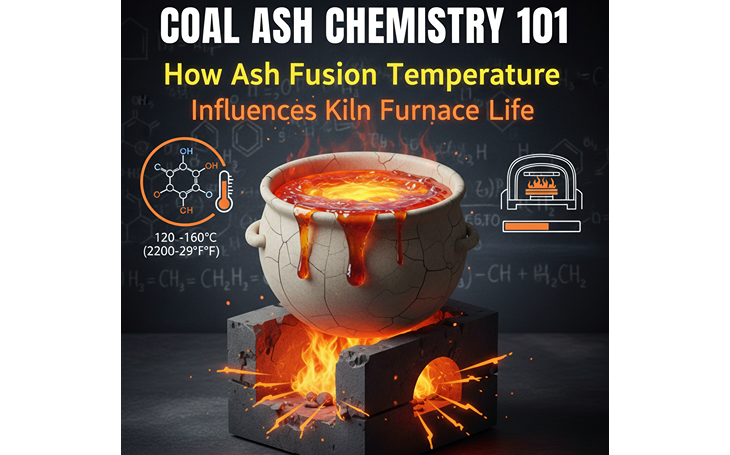
Coal Ash Chemistry 101: How Ash Fusion Temperature Influences Kiln and Furnace Life
Coal does more than provide heat. It brings ash into every furnace, boiler or rotary kiln it enters. This ash is made of oxides such as silica, alumina, iron, lime and magnesium. When temperatures rise, these components react, melt or fuse. If the ash melts too soon, it becomes sticky and forms clinker or slag. If it stays solid at the right range, equipment operates smoothly. Understanding ash fusion temperature is the key to keeping heat systems alive.
This topic matters most for sponge iron plants, cement kilns, steel furnaces and high-temperature boilers. They run continuously, and a small mistake in fuel selection can cost weeks of downtime.
What is ash fusion temperature
Ash fusion temperature, often called AFT, describes the point at which coal ash begins to soften, deform and finally melt. Testing labs use standard heating profiles to identify four important stages:
◾ Initial deformation temperature IDT
The moment ash begins to soften.
◾ Softening temperature
Edges round off and ash begins to lose structure.
◾ Hemispherical temperature
Ash slumps like a dome, indicating major melting.
◾ Flow temperature
Ash liquefies and spreads like molten metal.
A coal grade with low fusion temperatures will melt earlier and stick to furnace surfaces. A high fusion temperature resists slagging and stays granular.
Why ash fusion matters more than calorific value
Buyers often chase calorific value first. They look at GAR numbers and ignore ash chemistry. This creates a problem: a high-energy coal that melts at lower temperatures can destroy transport pipes, refractory linings and burner nozzles.
Low fusion coal equals fast slagging
Ash clings to surfaces, forms hardened crusts and blocks air channels.
High fusion coal equals stable operation
Ash remains powdery, flows with exhaust gases and exits as manageable residue.
Energy output is meaningless if operators must shut down equipment every few days to scrape the lining.
Clinker formation: the silent killer
In a rotary kiln or furnace, slag begins as a soft sticky layer. It traps other ash particles, grows into lumps and hardens. These lumps are called clinker. Once clinker forms, heat transfer changes dramatically.
Clinker causes:
◾ Poor flame spread
◾ Uneven temperature zones
◾ Pellet or ore choking in rotary kilns
◾ Localized overheating
◾ Sudden discharge blockages
Kiln rings form when slag sticks to the drum interior. These rings grow like concrete, forcing shutdowns. Removal requires heavy machinery, abrasives or mechanical cutting.
Slagging and fouling in boilers
In boilers, slagging refers to molten ash sticking to high-temperature surfaces, especially furnace walls and superheater tubes. Fouling happens downstream, where ash deposits in cooler sections.
Both reduce heat transfer. Fuel consumption rises, steam output drops and metal fatigue accelerates. Even automated soot blowers cannot remove sticky slag. Eventually, operators schedule forced outages.
A coal grade properly matched to AFT reduces emergency cleanups and keeps boilers efficient.
Ash chemistry decides fusion behavior
Ash is not the same in every coal seam. Composition changes based on geology and mineral content.
Common ash components:
◾ Silica SiO2
◾ Alumina Al2O3
◾ Iron oxide Fe2O3
◾ Lime CaO
◾ Magnesium oxide MgO
◾ Alkali metals K2O, Na2O
Silica and alumina raise fusion temperatures. Iron and alkali metals lower them. When ash is rich in iron or sodium, it melts early, sticks to walls and causes clinker.
This is why two coals with the same GAR can behave completely differently inside a furnace. Composition matters more than the calorie number.
Matching coal grade to equipment temperature
Every industrial system has a temperature profile. Rotary kilns might run between 950 and 1100 degrees Celsius. Boilers often exceed 1200 at burner zones. The ash fusion temperature must sit comfortably above operating peaks. If it overlaps, melting begins.
General guideline:
◾ AFT 200 to 300 degrees higher than system temperature equals safe zone
◾ AFT close to system temperature equals slag risk
◾ AFT lower than system temperature equals failure waiting to happen
Industrial buyers should not rely on guesswork. They need certified ash chemistry and fusion reports at procurement stage.
Why cheap coal becomes expensive
Low-cost shipments are often cheap for a reason. They carry ash with low fusion points, high alkali content or unstable mineral balance. On paper they look within specs. In real kilns, they destroy refractory layers, burn operators time and stall production schedules.
Every shutdown means:
◾ Lost output
◾ Overtime labor
◾ Repair costs
◾ Demurrage and replacement fuel purchases
Cheap tonnes turn into costly failures.
How Gsinfotechvis protects industrial coal buyers
Gsinfotechvis Pvt Ltd supplies coal with documented ash fusion characteristics, not just calorific numbers. The company evaluates mineral content, ash percentage and physical stability before cargo leaves origin. This helps sponge iron plants, cement manufacturers and boiler operators avoid slagging disasters.
Clients benefit from:
◾ Verified ash fusion temperature profiles
◾ Controlled ash composition suited to kiln and furnace operation
◾ Route planning to prevent moisture contamination
◾ Third-party inspection for Q&Q confidence
◾ Guidance on selecting coal grades per application
If your business runs kilns, furnaces or continuous thermal systems, ash chemistry is not optional. It is your insurance. Gsinfotechvis helps buyers choose coal that protects equipment, raises uptime and keeps operations predictable.
Follow us on LinkedIn.